. "Are Facebook "likes" protected by the First
Amendment? A recent ruling by a court in Virginia raises questions about
free speech in the digital age.." Upfront Magazine 2012. 14 Jan.
2013
<http://www.thefreelibrary.com/Are+Facebook+%22likes%22+protected+by+the+First+Amendment%3F+A+recent...-a0310150547>.
Tuesday, January 15, 2013

Tuesday, December 18, 2012
Why?
The Hour I First believed by Wally Lamb


I just started this book, but one of the first things that
happened was a school shooting. It was done by two boys, Eric Harris and Danny
Klebold, in their high school. I couldn’t help but relate it to what happened
Friday in Sandy Hook Elementary.
It struck me how accurate Lamb’s description was. After the
shooting, the school became a crime scene, and parents were hopefully reunited
with their children at a separate location. There were memorials and funerals
for the gone, and there were crosses put up in their memory. Teachers made
sacrifices for their students, and were recognized for their bravery. Lives
were lost for no reason, and people mourned.
I really got what his characters were feeling throughout and
after the shooting, especially because of what just happened. I think that
because of the shooting Friday, I got the story more and it struck me more
deeply. I wish it hadn’t happened, but it helped put my book into perspective.
One of the differences in the two stories was the motive. In
‘The Hour I First Believed’, Eric and Danny were sick of being bullied. Of
being picked on by the jerks. Of getting shoved to the back of the lunch line.
They decided to do something about it. That ‘something’ turned out to be
planting bombs and shooting. But they warned the few people they called their
friends, let them get away. Whereas in the tragedy on Friday, no one was
spared, and his motives are unknown.
All shootings are horrible, especially the one on Friday.
But we can learn from them. And in the case of this book, they help us
understand it better.
Tuesday, December 11, 2012
What Is Beauty?
The Little Giant of Aberdeen County by Tiffany Baker
What is beauty, really? Is it what’s on the inside or
outside that counts? These are questions tested in The Little Giant of Aberdeen County by Tiffany Baker.
The story is about Truly, a girl that is the size of a
giant. Even as a newborn, she weighed about 20 pounds. With a ‘perfect’,
gorgeous, skinny sister like Serena Jane and no mom in the family, Truly’s life
was a mess. She moved in with the crazy, poor family while her sister was
adopted into a rich one. And when Serena Jane married the doctor and died,
Truly was forced to move in with him for the sake of Serena’s son, Bobbie.
Serena, from the start, is the beautiful one, at least on
the outside. Yes, she was nice, too but she didn’t care for Truly. Truly had
the more beautiful inside. But no one judges from the inside. Everyone loves
Serena more, and no one pays attention to Truly except to tease her. Only
Marcus, another outcast, even speaks to her. He loves her, and he sees her for
what she really is, not what everyone else thinks. I think that he sees what
everyone else should. He sees real beauty.
I think that without seeing Truly’s side of the story, you
would start to think what everyone else thinks. You might not want to, but you
can’t help it. A poor girl who wears boy clothes and is huge- what would you
think? People can’t really help but think like that. No one wants to, but it
does happen.
I think that Truly really shows what beautiful should be
like. She stays strong even with all of the teasing, doesn’t want to get
revenge when people bully her, she worked so hard in a family that wasn’t hers,
and left that family to take care of her nephew. She was a kind, selfless
person, and that should be what beauty is about.
Tuesday, December 4, 2012
A Scream of Triumph? Or Despair?
Fox by Margaret Wild and Ron Brooks

This week I read Fox by Margaret Wild and one of the lines that stood out to me was, "In the stillness, Magpie hears a faraway scream. She cannot tell if it is a scream of triumph or despair."
Fox is about Dog and Magpie, Two best friends who help each other. Dog helps Magpie "fly", and Magpie helps Dog see. They live happily together until Fox comes along. He pretends to be their friend, until he finally convinces Magpie to go with him. He runs across the desert and leaves her there alone. Magpie realizes what she did was wrong, and goes home to try and fix it.
The scream in the quote comes from Fox after he leaves Magpie alone. I think that it is a scream of both triumph and despair. I think that it was a scream of triumph because he had accomplished what he wanted to, taking Magpie away from Dog. He succeeded in what he wanted to do. But it is mostly a scream of despair for what he had done.
Confucius once said, “Before you embark on a journey of revenge, dig two graves.” I think that this means that revenge will not only hurt the person you are out to get, but yourself, too. And this applies to Fox screaming in despair. He didn't realize that what he had done was was wrong until he had already done it, but by then he was already hurt. Fox had separated the only two creatures who took him in and accepted him and were his friends. He was back to square one, all alone again. He was hurt by his actions, which was why he was screaming in despair. If you do something that bad to two friends like Dog and Magpie and end up without any friends, you will not only be guilty but even more lonely than before.
Tuesday, November 27, 2012
Keeping Secrets
The Pact by Jodi Picoult
Spoiler Alert!!!

This week, I read The Pact by Jodi Picoult. It really made me think about how much two people who really care for each other will sacrifice for their counterpart.
In The Pact, Chris and Emily have been best friends since before birth. They even had something the psychiatrist said happened when they had been together so long that their souls combined. If one hurt, the other hurt. So when Emily told Chris that she was going to commit suicide, Chris was devastated. He obviously didn't want her to, but he knew that she would be in worse pain if she didn't.
Chris and Emily were always together. They made small sacrifices everyday. For example, when Emily ratted out Chris so she wouldn't get in trouble, she went on a ski hill she didn't want to go on for him and ended up breaking her leg, but she didn't care. she had apologized, and that was all that mattered.
As Emily held the gun to her head, she asked Chris to shoot her. This must've killed him inside, and he will probably never forget that he agreed to kill his best friend, even if she possibly pulled the trigger herself. But he knew that she would die of hurt and pain inside her head, so he sacrificed his conscience to help her.
I think that Chris did what was right for Emily. Even if it didn't seem like that, she would've been hurting so badly and eventually killed herself anyway. Both of them would have been living in agony until she mustered up the courage to kill herself. I know that I couldn't have done what Chris did, and I admire him for that. Strong people sacrifice themselves for those they love, no matter what the cost. Chris ended up giving two lives, his and Emily's.
What would you have done? Do you think what he did was right?
Tuesday, November 20, 2012
Making Sacrifices
The Plain Truth by Jodi Picoult
Spoiler Alert!

I recently read 'The Plain Truth' by Jodi Picoult. It's about a lawyer who was given a job on an Amish farm- defending an 18 year old girl. Katie, the girl, is accused of murdering her child right after it is born. Ellie, the lawyer, has to live on the Amish farm until after the trial. At first, she is mad and annoyed by the lack of electricity and other people, but gradually she makes friends with the family.
Many sacrifices had to be made in order to let Katie get out of having to go to jail. First, her father, and the Amish community, have to agree to let a lawyer into their town and let her use her phone and computer. Her father is obviously mad, but he probably gave in because even though he was furious with his daughter, he loved her. This is the first sacrifice.
The second came from Katie, her mom, and her brother, Jacob, who had been disowned by his father for studying. Katie was sent by her mother to see Jacob in college for 6 years after he was disowned and temporarily banned from the community. When he came to see his sister and be questioned, all three of them had to reveal their secret to their father/ husband, who was horrified, disappointed, and mad. This takes courage.
One last sacrifice made was by Sarah, the mother, and Ellie. As Ellie was leaving, Sarah gave her the shears that had been used to cut Katie's umbilical chord and had gone missing. This revealed to Ellie that Sarah had killed her granddaughter for her daughter's sake. Ellie chose not to tell anyone and keep Sarah's secret safe. I think that this shows a lot about who Ellie is.
The whole family made sacrifices for Katie, and it payed off in the end. They all obviously love her, and I admire that. For example, I couldn't have done what Sarah did in the end. So I admire their strengths. It all worked out in the end.
Tuesday, October 23, 2012
Life's Obstacles
Vanishing Acts By Jodi Picoult
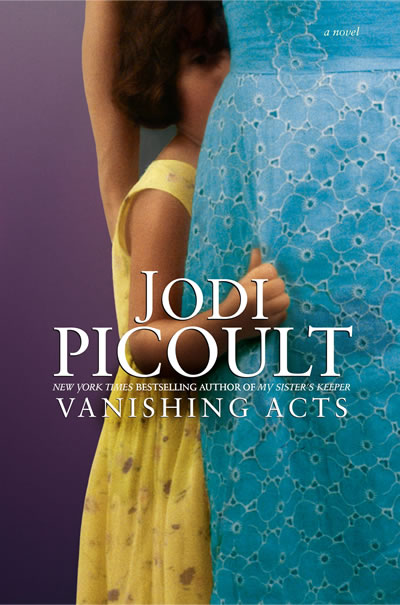
This week I read the book Vanishing Acts by Jodi Picoult. In it, the main character, Delia Hopkins, faces many challenges before she can live a better life. They also affect her emotionally. She doesn't know what she wants out of life, or how to live it, which causes problems. She wants her life to be normal again, but knowing it won't be crushes her.
One example of this is when she realizes she was kidnapped at age 4 from her mother by her dad. She always thought that her mom had died in a car accident, because she trusted her dad. I think that she had no idea what to do when she found out, so she went numb for a bit. She had never had reason not to trust her dad, and when she found out he had been lying her whole life, it killed her, as it would anyone else. No one wants to learn they've been living a lie.
Another example of this is Eric. Franz, their other best friend, still loves Delia, and she doesn't really realize it. But when she has problems with Eric, her fiance, she immediately goes to Franz. This kills him, knowing he's only second best. And when Delia finds out Eric's been drinking again and goes to Franz, it only creates more problems between them which she has to solve. This is probably very stressful to her, having to choose between her two best friends.
I think that Delia is having problems that anyone would. Her father is in jail, her mother has been alive for her whole life, and she doesn't know which friend she loves more. Everyone has problems they have to deal with, no matter how small. I think the author wants to show that no one has a perfect life or a life without problems. Picoult wants to show that you have to make your own choices, and everything might be ok in the end. Not perfect, but better. Also, she wants to show that you have to be strong and face your problems head on, otherwise they won't go away. This is what Delia does and for her, it works.
Tuesday, October 16, 2012
How Far Will They Go?
Vanishing Acts
Spoiler Alert!

In 'Vanishing Acts' by Jodi Picoult, it is really proved to you how far a parent will go to help their child. Especially when Arthur is accused of kidnapping.
Delia probably felt like she had lived a normal life, just without a mother. She had a loving dad, two best friends, and a house in the suburbs. But when her father is accused of kidnapping her, Delia's world turns upside-down. She finds out that her mom is, in fact, still alive and well and living in Arizona. What she finds out is that her dad kidnapped her when she was four, because her parents were divorced and her mother was a drunk. Arthur knew that he was facing huge charges when he left Arizona, but he went anyway for Delia's sake. I think that he wanted Delia to have the best life possible, and for him, that wasn't with her mom. So he risked a lifetime in jail for his daughter.
Another example is when Delia held off from saying yes to Eric's marriage proposal. She loved him, and they had been best friends since preschool, but she didn't accept, not until he stopped drinking. She says in the book that it was because she hated the smell of alcohol, but I think that it is partly because she had seen Eric's mom drunk when she was a kid and hated it, and she wanted what was best for their child. They didn't get married until he had stopped drinking.
This connects to my life because I know that parents do things every day for their kids, in order for them to have a better life. It might be something small, like giving their kid the last bit of ice cream when they want it for themselves. But it could be something extreme, like sacrificing their own life for their child's. They are constantly trying to make our lives the best they can, no matter what the cost.
Tuesday, October 9, 2012
The Better One: Sibling Rivalries
A Fraction of the Whole by Steve Toltz
Spoiler Alert!!!!!!!

This week, I read A Fraction of the Whole by Steve Toltz. It's about brothers Martin and Terry Dean and Martin's son Jasper. But Terry is Australia's most wanted criminal for killing people who cheated playing sports, and Martin was in a coma for the first 4 years of Terry's life. When he awoke, they met a criminal in jail at the time after Terry got an injury to his leg by knife and was prevented from being a sport prodigy. The criminal, Harry West, helps Terry and two 'friends' become better criminals. But Terry doesn't listen and stay hidden, he wants to be famous and create a name for himself so he murders cheaters. There is a forest fire in Martin's home town, killing his parents and Terry, who is trapped in jail. Or so everyone thinks. Then Harry writes a book about criminals and the publisher changes the author to Terry, because he thinks Harry is a pen name. This gets both the publisher and Martin (the editor) arrested, but Martin escapes with his other 'friend' to Thailand. They go to Eddie's friend, Mr. Lung, and Martin is shocked by what he sees. Terry is standing in front of him, obviously not dead. And by the way, Martin's wife was dating Terry before he 'died' and they obviously still love eachother.
I think that a problem constantly occurring in this story is sibling rivalry. It starts when Terry's later accomplices chase and tease Martin. At this point Terry is the talk of the town, being the best cricket player, rugby player, and swimmer, and he hates when people cheat. So when Martin utters the words, "they cheated", Terry attacks and they stab his leg with a knife, preventing him from ever playing sports again. Martin probably knew that they would attack, and didn't want to be living in his brother's shadow. Everyone compared him to Terry, and he must have felt like he was not Martin Dean, but 'Terry's brother'. But it backfired when Terry resorted to criminalism.
Martin later constructs a suggestion box for the town hall. The ideas started positive and helpful, but turned to, 'Terry Dean should be put in a mental hospital'. When he comes out, he starts murdering cheaters and becomes a famous criminal. Again, Martin is 'Terry Dean's brother". He was living in Terry's shadow and he felt cheated. Even his crush on Caroline, his neighbor, was ruined because she liked Terry more than him.
When Terry 'dies', I think Martin felt relieved and free. He didn't do anything to Terry, yet he was gone and couldn't outshine Martin. But he was still a shadow. So when he discovered that Terry was actually alive, well, and very rich, he was crushed. And he finds out that Terry has been caring for him, which probably makes him ashamed. Terry has, through Eddie, given Martin 2 jobs, huge sums of money, and a safe haven. Terry is still the top brother.
I think that most people with siblings can relate to this. I know I can. My brother will always do something that makes me feel like he's so much better than me, and my parents love him more, etc. And then he'll do something nice that makes me feel ashamed (he gave me the bigger room at our country house) and makes me dislike him even more for being nice to me, for being the better sibling. And he probably feels that way about me, just like Terry felt like Martin got more attention in his coma. I know that I can a lot of things better than my brother, but it doesn't feel like that a lot of the time. And this is what causes sibling rivalries.
Monday, October 1, 2012
Am I Blue?
The short story 'Am I Blue?' by Bruce Coville is about 16 year old boy Vincent, who can't decide whether he is gay or not. He finds out that he has a fairy godfather and three wishes to spend. When Melvin, the fairy godfather, turns everyone who is gay or has had a gay thought blue, Vincent discovers that more than one person he knows are hypocrites. And when Melvin lets everyone across America see who's blue, it creates a huge problem for them. They show that being a hypocrite is not good.
One person he discovers blue is Butch Carrigan, the school bully. Just earlier that day, Butch beat him up and called him a fruit. But when Melvin returns from Butch's house-- "Butch Carrigan was already blue as a summer sky"-- Vincent discovers that Butch was bluer than him. And he was probably teased for the rest of his school years for being a hypocrite. If he had admitted to everyone that he was gay in the beginning, there would have been less trouble for him when everyone turned blue.
Another hypocrite, an even bigger one than Butch, was one Vincent saw on TV. The victim was a Republican congressman. That congressman happened to be talking about "the great crime of homosexuality" and "the gay threat to American youth". He was not only talking about gay people in a bad way, he was in a political party against what he was. I think that they became hypocrites after they realized they were gay. They probably didn't want anyone else finding out and ridiculing them. Butch didn't want to be teased, so he beat up other gays. The Republican Congressman didn't want to be found out, so he hated on gays.And maybe some people who are gay didn't realize it or didn't admit it to themselves until it was too late. For example, Mr Albert, "the fat guy who ran the grocery store, looked like a giant blueberry- which surprised me, because he was married and had 3 kids". When his wife and kids saw him, they would be confused and possibly mad that he never said anything. And vice versa. "Ms Thorndyke, the librarian, who everyone knew was a lesbian, didn't have a trace of blue on her". She might have not known it herself, as everyone assumed she was gay.
Everyone seeing the blue was probably a lot easier on Vincent, who everyone knew was a bit gay. He wasn't hypocritical and it paid off.
I think that being a hypocrite is bad, even though many people, including me, go against what they sad or thought. sometimes it is for the better- for example, you hate someone, but are nice to them- but most of the time it is wrong and will just end up hurting you. Say the person you were being nice to finds out you've hated them all along. they will hate you more than if you just admitted that you didn't like them from the beginning. And everyone hates a hypocrite, especially if it affects a lot of people or is about themselves.
This story shows that being hypocritical doesn't pay off and usually ends up coming back and hurting you.
Subscribe to:
Posts (Atom)